The Most Valuable Page in Your Portfolio Has No Numbers On It
Why keeping a trading journal might be your only durable edge in the age of AI disruption
I've been in and out of tech since '98 — as a builder, as an evangelist, as a user, as a mentor. During that time I've watched business realities reshape themselves, sometimes slowly, sometimes overnight, across web, ecommerce, social media, mobile, advertising, marketing technology, video production, financial markets, tourism, and a dozen other industries. If you've spent any meaningful time in this world, you've probably watched a few of those shifts yourself.
So when Goldman Sachs published a report last week tracking 20,000 Americans over four decades to measure what happens when technology eliminates jobs, I didn't read it as an abstract study. I remembered parts of my own journey — people I've worked with who got caught on the wrong side of a transition, industries that rewired themselves faster than the people inside them could adapt. And I read it as a cautionary tale about what might come next.
Their finding wasn't pleasant. Workers displaced by technological shifts didn't just lose income temporarily. They earned nearly 10 percentage points less over the following decade than peers who were never displaced. They slid into lower-skilled roles — what the researchers called "occupational downgrading" — because the same forces that killed their jobs also eroded the value of everything they knew how to do.
The group hit hardest? Workers between 25 and 35. They delayed buying homes. They accumulated less wealth. They were less likely to be married at any given age. The economic shock didn't stay in their bank accounts — it rippled into the architecture of their entire lives.
This isn't abstract anymore. Over 52,000 U.S. tech workers were laid off in the first three months of 2026. Goldman estimates AI is eliminating roughly 16,000 net jobs per month. The disruption arrived while most of us were still debating whether it would.
When your career gets volatile, your investment decisions carry more weight
Here's the question I keep circling back to: if professional life is becoming less predictable for an entire generation, shouldn't investment decisions become more disciplined, not less?
Because that's not what happens. I've seen it — in myself and in others.
Every transition I've lived through carried a stretch of genuine financial uncertainty — new country, new currency, everything to prove from scratch. And during those stretches, every market movement felt personal. I checked my portfolio too often. I reacted to headlines that had nothing to do with my thesis. I made decisions I wouldn't have made if I'd simply written down why I was making them before I clicked.
Every behavioral finance study confirms this pattern. Daniel Kahneman won a Nobel Prize essentially proving that we humans are terrible at financial decisions under stress. We know this intellectually. We do it anyway.
The problem isn't knowledge. It's the absence of a system.
What a trading journal actually does (and what it doesn't)
Most investors track outcomes — what they bought, what they sold, how much they made or lost. That's a scoreboard. It tells you what happened. It tells you nothing about why it happened, or what you were thinking when you made the decision, or what you were feeling.
And the why is where the edge lives.
A trading journal — a real one, not a spreadsheet with ticker symbols and dates — captures the decision, not just the result. What did you buy? Why did you buy it? What was your exit plan? Were you calm, anxious, excited, bored? Were you reacting to a headline, following a thesis, or just feeling left out?
This is exactly why we built the trading journal at The Balanced Investor Club. When you open or close a trade, structured prompts appear: why this instrument, why now, what's your plan. Writing those answers down before you act forces a pause between stimulus and response. And that pause — that small, quiet moment — is often the entire difference between a reactive trade and a deliberate one.
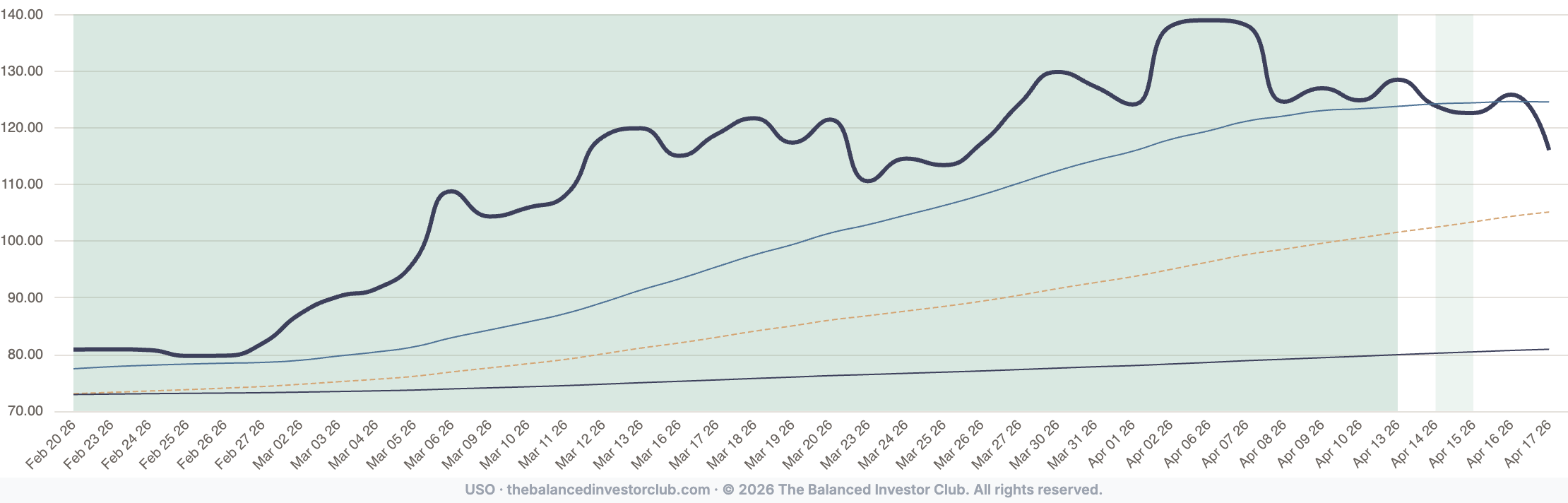
I think about this constantly during weeks like these. Oil at $112, inflation data surprising to the upside, geopolitical deadlines shifting by the hour. These are the moments when the emotional brain wants to hijack the controls. A journal doesn't eliminate the emotion. It gives it a seat at the table without handing it the wheel.
The patterns that emerge are more valuable than your P&L
Over time, something else shows up. Patterns.
Maybe trades logged on high-anxiety days consistently underperform. Maybe the best entries happen when the pre-trade notes are longer — when the reasoning was actually thought through before acting. Maybe the worst decisions cluster around the same emotional trigger: FOMO after watching a ticker run for three straight days.
But here's what matters: correlation isn't causation. A small number of trades can produce misleading patterns. The analytics are a mirror for reflection, not a trading signal. Using them to ask better questions about your process is key to improving the process itself, not to predicting your next result.
Nobody can predict markets. But anyone can understand themselves better as a decision-maker. In a world where the macro environment is genuinely uncertain, understanding your own process might be the only durable edge available to an individual investor.
Why we built this — and why now
When we started The Balanced Investor Club, we had a simple conviction: the opportunities you get in life are tied to the education you had access to. More education, more opportunities.
The Goldman report had one encouraging finding buried in the data: workers who retrained after a technology-driven job loss saw modestly higher wages and more stable employment over the next decade. Adaptation works. But it requires intention. It doesn't happen by accident.
The same logic applies to investing. The market doesn't care about your stress level, your career uncertainty, or whether you slept well last night. But your journal does. And over time, the patterns in your reasoning and emotions become more valuable than the P&L itself.
In a year when everything feels like it's changing faster than anyone expected, the most productive thing an investor can do isn't find the next great trade. It's understanding how they make decisions in the first place.
If this resonates, let's talk
I'm genuinely interested in how other people navigate this — especially if you're investing through a period of career uncertainty. If you want to explore how a structured trading journal could help you build better habits, reach out. You can find me on LinkedIn or through our contact page. No pitch, no pressure — just a conversation between people who believe discipline beats speculation.
— Lu
The Balanced Investor Club is an educational platform that helps investors develop discipline through tools like a structured trading journal, market sentiment tracking, and behavioral analytics. The content above is for informational and educational purposes only and does not constitute personalized investment advice, a recommendation, or a solicitation to buy or sell any securities. All investing involves risk, including the possible loss of principal. Past performance does not guarantee future results. Individuals should consult a qualified financial professional before making investment decisions. We're educators, not advisors. Your decisions are your own.
Sources: Goldman Sachs Research, Pierfrancesco Mei & Jessica Rindels, April 2026 (Fortune, WSJ, Yahoo Finance). Challenger, Gray & Christmas, Q1 2026 Tech Layoffs Analysis.