
Trading Journal
Finance
Investing


Most investors think diversification means safety. It doesn't. It means you've eliminated the risk you never needed to take — and kept the one you can't avoid.
SPY holds 500 companies across 11 sectors. Apple, ExxonMobil, JPMorgan, Tesla. Different industries. Different balance sheets. Different business models.
And yet, in March 2020, they all fell together. SPY dropped 34% in 33 days. That was diversification working exactly as designed — and exposing the risk it was never built to remove.
Every stock carries two types of risk.
Unsystematic risk: the risk specific to a company. An earnings miss. A product recall. A CEO scandal. Real, but optional. You can eliminate it just by owning more stocks.
Systematic risk: the risk tied to the market itself. Recessions, rate hikes, geopolitical shocks. This one cannot be diversified away. It follows you regardless of how many positions you hold.
The first risks comes with a return. The second one is just cost.
Harry Markowitz, 1952. The observation: a portfolio’s risk is not the average of its components’ risks. It depends on how those components move relative to each other.
If Asset A falls 10% while Asset B rises 8%, your combined portfolio barely moved. Neither asset changed. The combination reduced the exposure.
The efficient frontier maps every possible combination of assets. The upper edge is where portfolios offer the highest return for each level of risk. Below the frontier: portfolios you can improve without taking more risk.
SPY at $648.57 today sits near that boundary by construction. Its 500-stock composition has already done most of the diversification work.
The Capital Asset Pricing Model puts a number on it.
E(R) = Rf + B x (Rm - Rf)
Three inputs:
Rf — the risk-free rate. US 10-year Treasury: approximately 4.3% today.
Beta (B) — how much the asset moves relative to the market. SPY’s beta: 1.0. It is the market.
(Rm - Rf) — the equity risk premium. Historically around 5.5%.
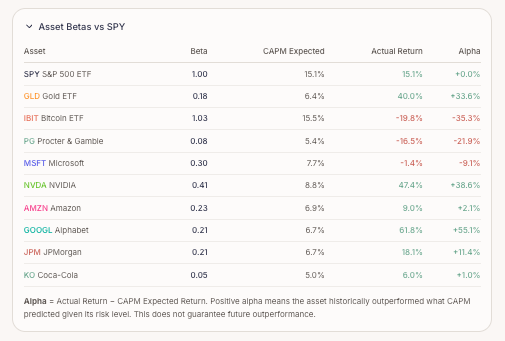
Applied to SPY: 4.3% + 1.0 x 5.5% = 9.8%
That 9.8% is the theoretical compensation for holding systematic risk over the long run. SPY returned 12.98% over the past year (from $481.80 to $648.57 at today’s price). The gap between 12.98% and 9.8% is approximately 3.2 percentage points. In CAPM terms, that’s alpha: return above what the model predicted.
APM assumes correlations between assets are stable. They are not.
During normal markets, SPY’s 500 components move at different rhythms. The diversification math holds. When markets sell off, correlations spike toward 1.0. Everything moves together. The diversification built during calm periods compresses exactly when it would be most valuable.
That is predictable behavior, not a model failure. The efficient frontier is drawn from historical data and diversification works in normal markets. In a crash, normal stops. Most investors discover this at the worst possible moment.
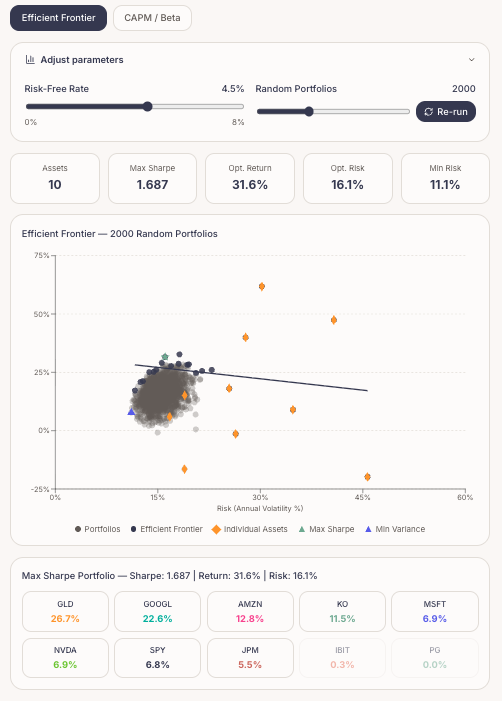
The CAPM & Efficient Frontier lesson on The Balanced Investor Club shows the efficient frontier live, built from 10 instruments. Two things worth doing:
First: Run the frontier. Watch where individual assets sit relative to the boundary. Most fall below it. Combining them moves the portfolio up and to the left: more return, less risk for the same allocation.
Second: Apply the CAPM formula. Use today’s 10-year Treasury rate as your Rf. Look up SPY’s current beta on the analysis page. Estimate your equity risk premium. Calculate the expected return. Then compare it to what SPY actually delivered over the past 12 months.
The gap between those two numbers tells you whether the market is paying you more or less than systematic risk implies.
Write both in your Journal.
Most investors never know if the market is paying them fairly for the risk they're carrying. Now you can. The formula takes 5 minutes. The data is already there.
📌 This is the 2nd piece in Do It Yourself with The Balanced Investor Club, a 14-part series where we take each foundational investing concept from the Learn section and apply it to real market data. Concept by concept. No theory without numbers.
Next week: Momentum. How trend continuation and price inertia can be quantified, and what the data says about whether it persists.
The instruments in this analysis — and the 13,000+ others we track — are available inside The Balanced Investor Club. Market data, trading journal, and structured learning in one place.
Educational content — Not investment advice. The Balanced Investor Club provides tools and information for educational purposes only. Nothing on this site constitutes financial, investment, or trading advice, nor a recommendation to buy or sell any security. Past performance does not guarantee future results. Your decisions are your own. Read our full disclaimer.
