
Trading Journal
Finance
Investing


Most investors track dozens of assets. Across 5 tabs. Three apps. A spreadsheet they stopped updating.
The result: they check prices constantly but never feel on top of things. Informed and anxious at the same time. And when the market moved, they reacted because instead of having a plan, they had too much noise and no filter.
Switching to one clean list changed how I think about my portfolio.
I stopped reacting to everything that wasn’t on the list. If you ask me, that’s the real job of a watchlist: to help you ignore the right things. Checking your watchlist instead of your blood pressure. That's the goal.
Here is how to build a watchlist that holds up.
Start with the instruments you already hold. Every one of them deserves a place on your list — because you need context on what you own before you add anything new.
Once those are in, you can expand. But the filter is strict: only add something you understand well enough to explain to someone else in two sentences.
A watchlist should not become a wishlist or a parking-lot for random ideas you pick up on social media.
A practical ceiling: 15 to 20 instruments. Enough to be diversified. Few enough to actually follow.
If you want to add something new, remove something first. Don´t fool yourself: a too-long watchlist is just noise with a different interface.
A ticker alone tells you nothing about why something is on your list. Add a one-line note for each instrument: why you are watching it, what would make you act on it, what would make you remove it.
This turns a passive list into a decision framework. When the market drops 8% in a day, you open your list and the note says: “watching for entry below $X — thesis still valid.” That is preparation.
When the market moves, you already know your criteria. You are not deciding under pressure — you decided when you were calm.
Daily price-checking is anxiety with a habit loop attached. Set one moment per week to review your list. Are the reasons you added each instrument still valid? Has anything changed materially? Do you need to act, or just note it?
Most of the time, the answer is: note it and move on. Over time, that habit — reviewing with criteria, instead of reacting to noise — is what separates investors who compound from those who churn.
The Balanced Investor Club includes Watchlists built around this logic — stocks, ETFs, and other instruments in one clean view.
If you already have a list scattered across apps and tabs, consolidating it in one place is the first step.
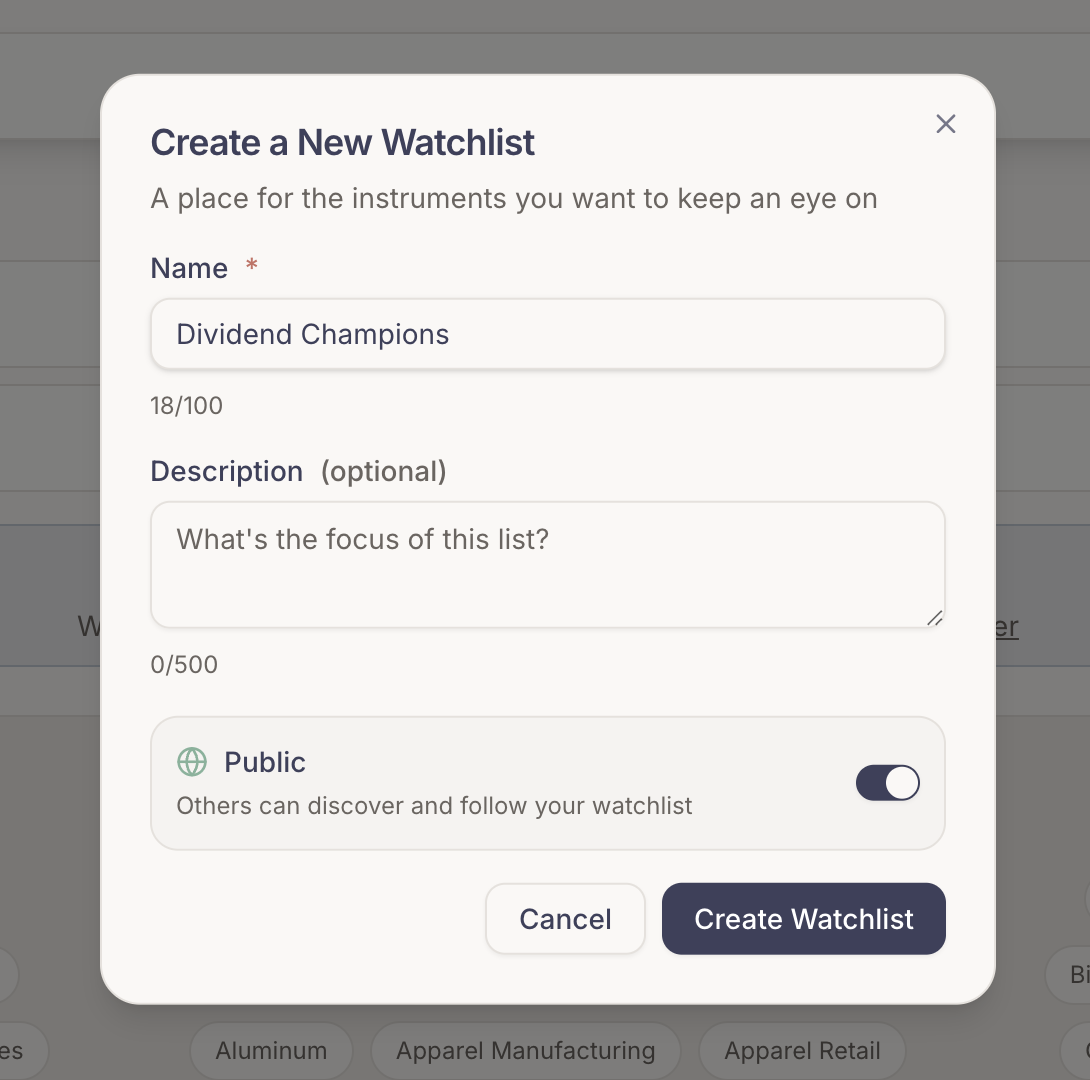
You can start from scratch and build your own. Private or Public.
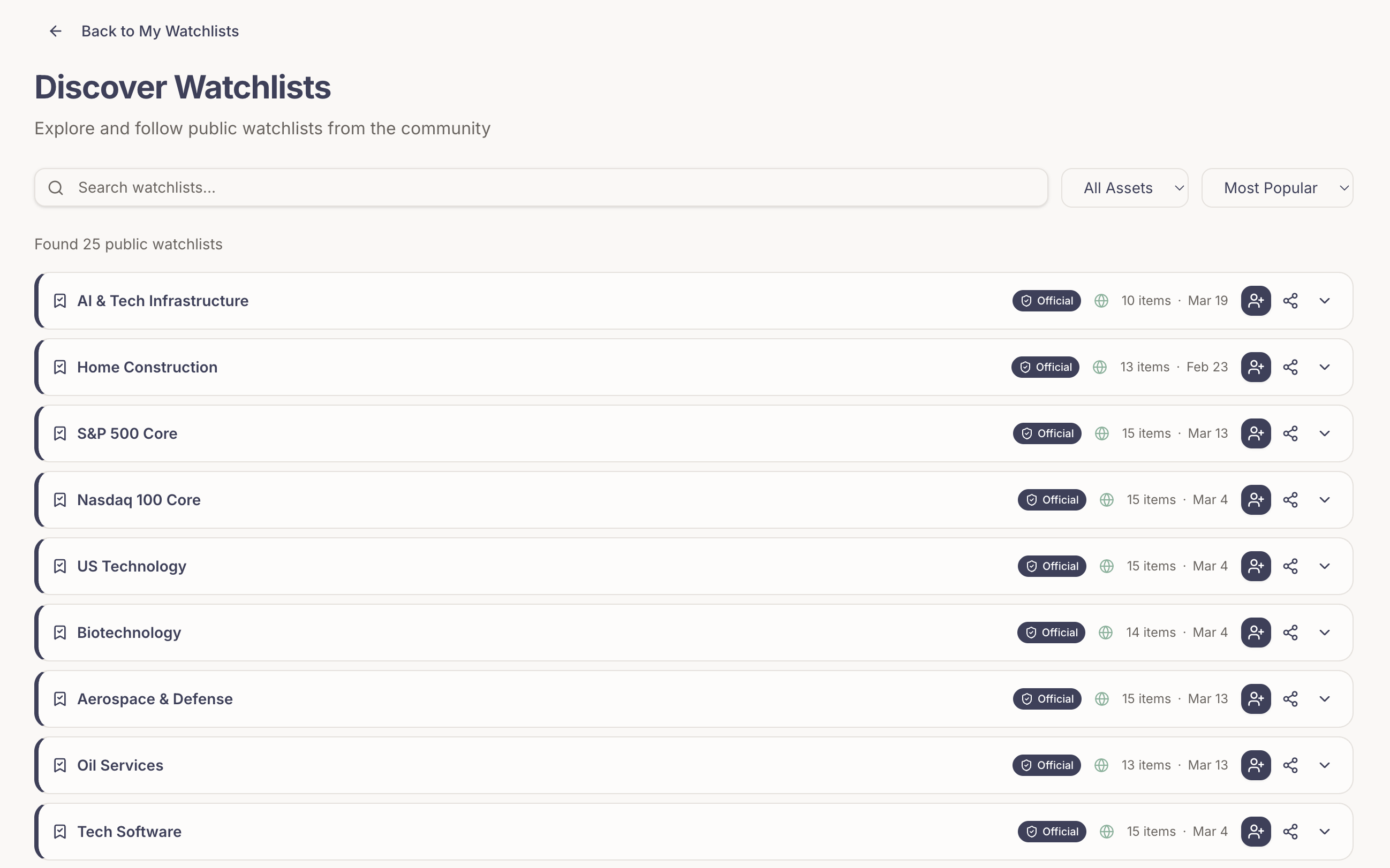
 Or browse curated watchlists to see how other investors structure their lists before you commit to yours. Either way, the act of deciding what belongs on a single list forces the clarity that scattered tabs never will.
The Watchlist feature and many others are available inside The Balanced Investor Club. Market data, trading journal, and structured learning in one place.
Educational content — Not investment advice. The Balanced Investor Club provides tools and information for educational purposes only. Nothing on this site constitutes financial, investment, or trading advice, nor a recommendation to buy or sell any security. Past performance does not guarantee future results. Your decisions are your own. Read our full disclaimer.
