
Trading Journal
Finance
Investing


The S&P 500 is the index most investors use as a proxy for the broad US market. It tracks 500 of the largest publicly traded companies in the United States. In most conversations, when someone says "the market returned X%", they mean the S&P 500. SPY is the ETF that lets you track it like a single stock. One of the most liquid instruments in the world, and the one we use throughout this series to ground every concept in real numbers.
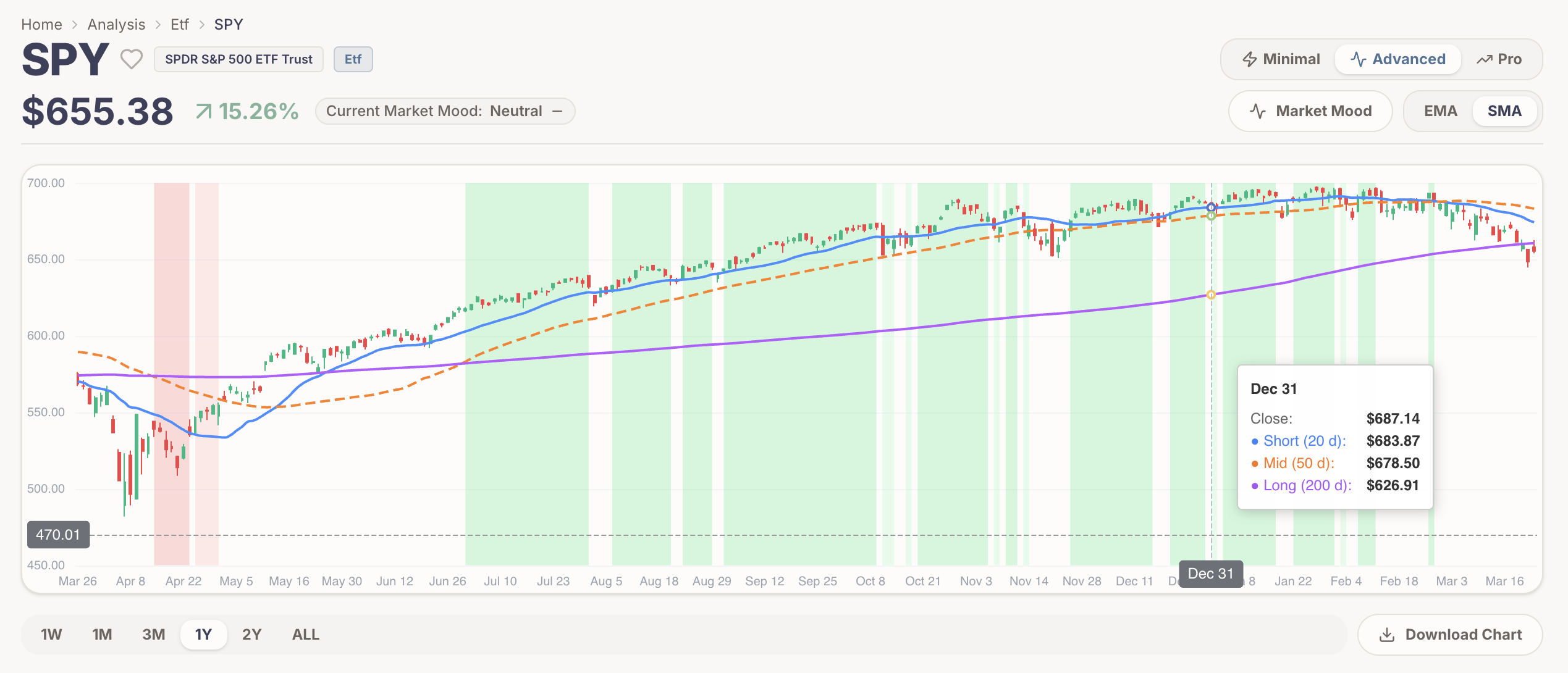
SPY returned 16.59% over 2025 from $589.39 (Jan 2) to $687.14 (Dec 31). Price return, not including dividends, one of the cleaner runs the S&P 500 has produced in recent memory.
 The number everyone quotes vs. the number that actually matters
If you held it, that number felt good. Here is what your brokerage app did not show: 16.59% was not your real return.
Every return figure in a headline, a fund factsheet, or a brokerage notification is nominal. It measures how much the number on screen changed. But can you buy more things than last year — or less?
That question has a name: the time value of money.
The idea: a dollar today is worth more than a dollar tomorrow. Two forces drive it, one works in your favor, one works against you.
FV = PV x (1 + r)^n
$10,000 at 7% annual return for 10 years = $19,672. Not $17,000 (that would be simple interest). The extra $2,672 comes from returns compounding on top of previous returns. The exponent does it.
Same decade, different rates, very different outcomes: 5% gives $16,289. 9% gives $23,674.
Real Value = Nominal Value / (1 + i)^n
That $19,672 after 10 years at 3% annual inflation is worth $14,635 in today's purchasing power.
Nominal gain: $9,672. Real gain: $4,635. Inflation took the rest slowly, consistently, across 10 years that most investors never measured. That is why inflation is known as the silent thief.
The gap widens over time. It compounds the same way returns do.
Fisher equation:
Real Return = (1 + nominal) / (1 + inflation) - 1
7% nominal with 3% inflation: roughly 3.9% real return, not 4%. Compounded over 30 years on a meaningful sum, that 0.1% matters.
Back to SPY: 16.59% nominal over the past year. Apply 3% inflation. Real return: approximately 13.2%. Still strong. More honest.
In the 1970s US inflation ran above 10% for several consecutive years. Nominal returns on many assets looked positive. Real returns, in many cases, were negative.
Account balances were growing. Purchasing power was shrinking. Most investors did not notice until much later.
That gap between the number on screen and the value of that number is small in low-inflation environments. It becomes significant when inflation runs hot. The habit of asking 'nominal or real?' costs nothing to build and pays off when it matters.
The Time Value of Money lesson on The Balanced Investor Club includes an interactive calculator. Four inputs: initial investment, annual return, inflation rate, time horizon.
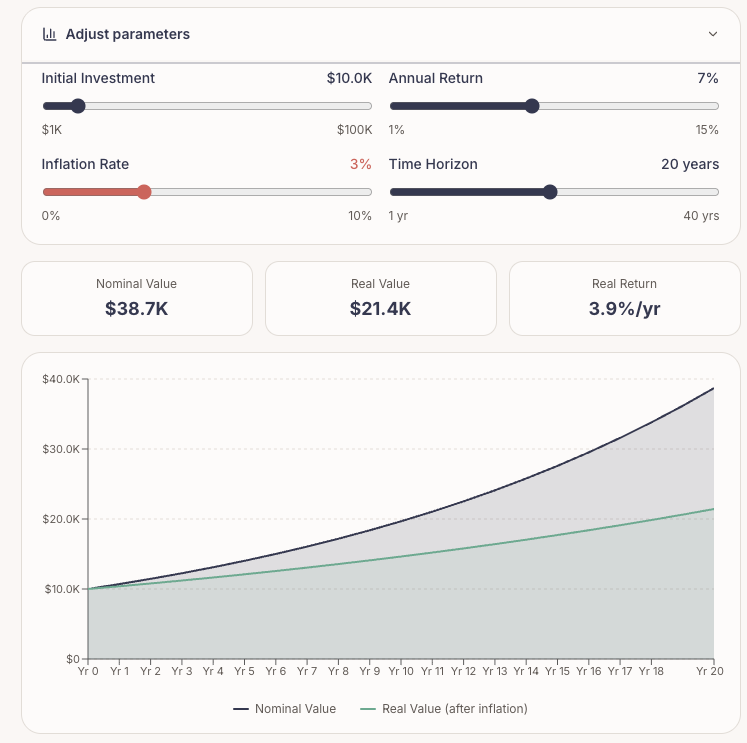
Three scenarios worth running:
Scenario A vs B: 7% return with 3% inflation over 20 years. Then 4% return with 0% inflation over 20 years. The nominal outcomes look very different. The real outcomes come out nearly identical.
Scenario C: Push inflation above the return rate. Watch real purchasing power decline as the account balance rises. This scenario has happened. It can happen again.
Then open SPY's analysis page and apply the calculation to the past 12 months. What was the real return, given your inflation estimate?
Write it in your Journal. Compare it to the number your brokerage app showed. The gap between those two figures is where clear thinking about money starts.
Next time you review your annual returns, do not stop at the number your brokerage app shows. Apply the Fisher equation. Factor in your inflation estimate. That single habit, applied consistently, is the difference between tracking a number and understanding what it means.
📌 This is the first piece in Learn and Do It Yourself with The Balanced Investor Club, a 14-part series where we take each foundational investing concept from the Learn section and apply it to real market data. Concept by concept. Theory and numbers.
Next week: CAPM and the Efficient Frontier. What the model actually says, and what it quietly assumes.
The instruments in this analysis — and the 13,000+ others we track — are available inside The Balanced Investor Club. Market data, trading journal, and structured learning in one place.
Educational content — Not investment advice. The Balanced Investor Club provides tools and information for educational purposes only. Nothing on this site constitutes financial, investment, or trading advice, nor a recommendation to buy or sell any security. Past performance does not guarantee future results. Your decisions are your own. Read our full disclaimer.
